Nearly every large company has the page. Integrity. Innovation. Customer focus. Respect. In a study of 689 large, mainly American organizations, 562 published an official set of values. Integrity appeared in about two-thirds of those statements.[1]
The page carries an expectation: because these words have been announced, people will behave accordingly. The company believes it has a culture, and that culture is supposed to act as a silent supervisor. People will produce the conduct the organization believes it wants without anyone having to enforce it.
This author’s earlier essay argued that companies do not have a culture. They have a byculture, a word coined there for the rules, written and unwritten, that people follow at work, and the habits those rules produce. That argument was about the name. This one is about the job the name is expected to do.[2]
What the page lists are standards of conduct, not the company’s values. A value belongs to a person or a community. It can outlive the job. A company can require honest conduct. It cannot announce a shared conviction into existence. A standard that nobody holds anyone to is not a standard. It is a hope.
The distinction becomes costly when the company expects belief to make up for what its own arrangements fail to support. When the employer will not bear the cost of its standards, someone else does.
The Purchase
Start with sympathy, because the purchase makes sense. Every company needs honest expense reports, deadlines met, customers told the truth, and problems reported by the people who find them.
Making those expectations dependable takes work. A standard must distinguish a breach from a judgment call. Someone must be able to notice. Rewards and penalties must support the same conduct. Reports require investigation, and reporters need protection, sometimes from someone senior.
The bill is highest when the breach belongs to the top salesperson, the founder’s friend, or the engineer nobody can replace. Upholding the standard may cost revenue or a relationship. Publishing it costs neither. Delivering a consequence is work most managers would rather not do, and a company has to be careful about the few who would.
That is what paying for conduct means here. Money is only part of it. The payment includes attention, time, promotion decisions, assignments, standing, and difficult conversations. A standard backed by those commitments is funded. One without them is not.
A standard is paid for the way rent is paid, not the way a building is bought. The attraction of the product is ownership: buy it and possess the result. Conduct is a running cost, due again whenever the standard becomes inconvenient. A habit may need fewer reminders once established. It still needs support when someone powerful wants an exception.
Into that expense comes a promise. State the values, hire for them, train to them, and people will hold themselves and one another to them because they believe. One statement reaches thousands at once. Nobody has to be the enforcer. A leader who buys it is not foolish. She is doing what any buyer does when offered the cheapest tool for an expensive job, and part of what she is buying is relief from conflict.
The seller’s interest is understandable too. Statements, workshops, and surveys can be packaged and repeated. The decision to confront a valuable employee cannot. The product is also almost impossible to prove a failure, because a thing nobody can define can never be shown not to have worked. Without a clear test of changed conduct, it is easy to sell activity without an agreed finish.
Neither side needs to be dishonest. The problem is a product that promises the result without the continuing work.
Why A Statement Cannot Enforce Itself
Conduct follows consequence. People learn the rules of a workplace by watching what happens. That is not a low view of people. It is how anyone learns a new place. The page competes with the sales plan, the promotion list, and the response to the last person who brought bad news. Those arrangements have consequences attached. An unsupported statement does not.
Edgar Schein understood this. He wrote that stated values often leave behavior unexplained. Some describe aspirations rather than practice. Others are rationalizations for what already happens.[3]
His primary mechanisms concern what leaders do: what they notice and measure, how they react in a crisis, allocate resources, teach, reward, recruit, promote, and remove. Formal statements are secondary. In a growing organization, he argued, they work only when consistent with the primary mechanisms. Otherwise, they may be ignored or create internal conflict.[4]
Anyone who accepts Schein’s account, and most people in the field do, has already accepted that a statement cannot regulate conduct on its own. If the page says integrity and the promotion list says otherwise, his model predicts the page will be ignored or become a source of conflict. The gap is not a puzzle the model fails to explain. It is what the model predicts.
Practitioners who change incentives, promotion decisions, and leadership behavior are working on those mechanisms. They may call the result culture. This essay calls it conduct that was paid for. The objection is not to that work. It is to selling statements and workshops as substitutes for it.
Schein described a utility that ordered workers to report and clean up oil spills. Electricians objected that this was not their work. Management insisted, trained them, and lost some who quit. About five years later, workers described the cleanup as the right thing to do.[5]
The order came first, and it worked because it was funded: one behavior, named, enforced, trained, and the few who would not follow it gone. What followed was willing compliance, then an understanding of why the practice mattered, and in the end a habit. Schein described values catching up with behavior.[5] This essay reads the case differently. The utility did not acquire a culture. It established a habit, first held by an order and later by the workers themselves.
The product sells that sequence in reverse. It announces the identity first and expects behavior to follow.
Changing thousands of habits in the same direction is difficult. That difficulty does not establish that the company possesses a culture. Researchers who traced the idea of resistance to change argued that people may resist losses of pay, standing, or comfort.[6] The distinction directs attention to what the change costs, not simply to employees’ willingness to accept it.
A single person changes her habits every time she takes a new job. The difficulty is scale and direction, and what meets it is governance: a consistent and trusted system of consequences, rewards and costs alike, kept in place long enough for the new conduct to become the default.[7] Once it is the default, it no longer needs the order. From the outside it looks like a culture. It is a habit that was paid for.
From the outside it looks like a culture. It is a habit that was paid for.
What The Gap Measures
Schein explained why statements and conduct diverge. This essay asks who carries the difference. It treats the gap as a bill for conduct the company has announced but has not supported.
The gap also reveals what the company wants, which may differ from what it believes it wants. Innovation appears on the page while unsuccessful experiments count against promotion. Customer focus appears on the page while the sales plan rewards volume regardless of need.
Once a company sees what its incentives produce, continuing to reward that conduct is a choice. The page is the company’s wish about itself. The plan with numbers in it is its will. The gap between the two is not a measurement error. It is the most accurate statement of the company’s priorities in existence, and almost nobody reads it that way.
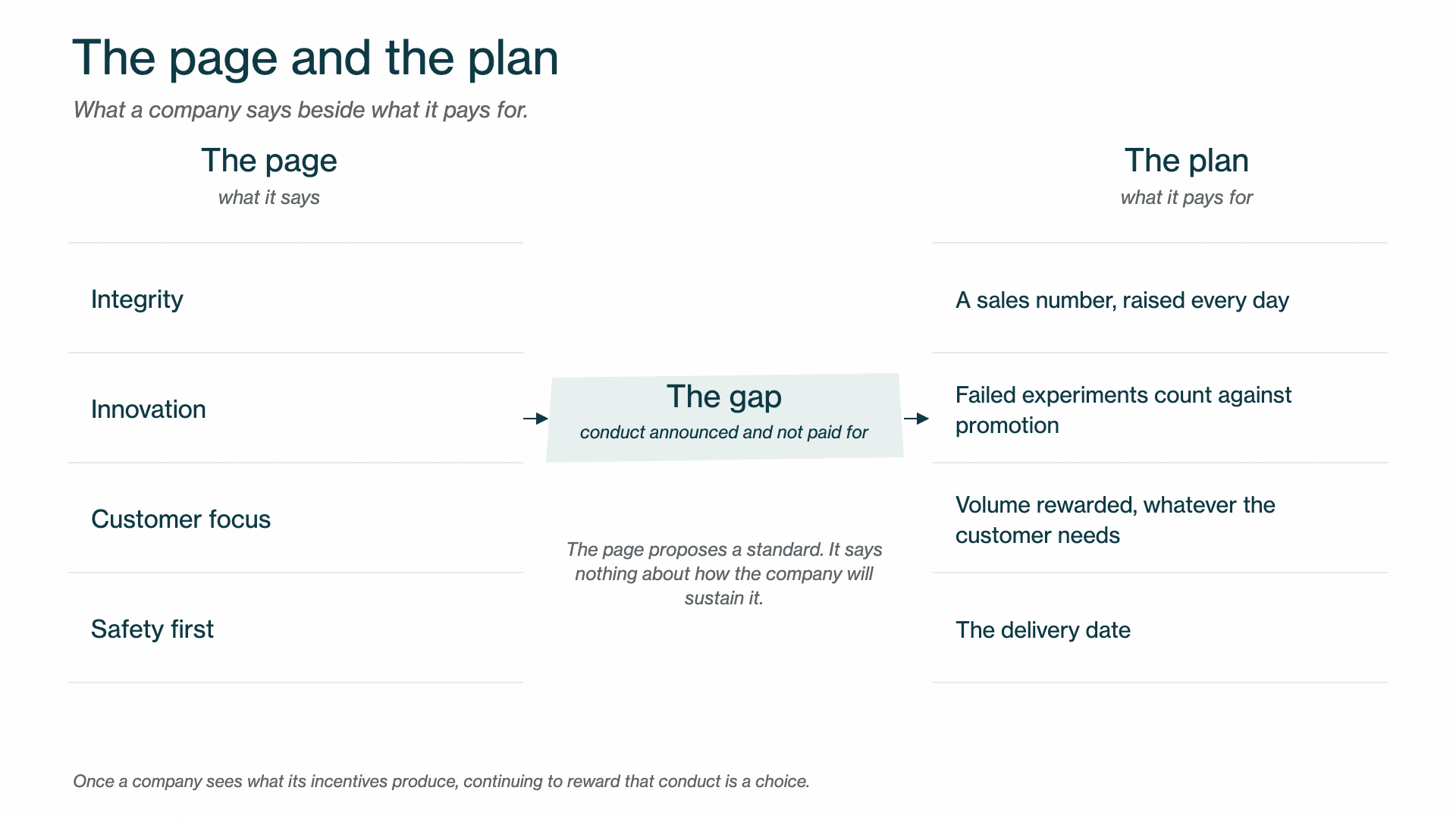
Wells Fargo’s vision promised to meet customers’ financial needs and help them succeed. Its 2010 annual report also promoted eight products per household because, the chairman wrote, eight rhymed with great.[8] The board’s investigation found that misconduct rose as sales goals became harder to achieve. Employees feared penalties for missing them. About 5,300 employees were dismissed over five years for sales-practice violations, while the goals remained until 2016. In August 2017, the bank raised its estimate to 3.5 million potentially unauthorized accounts.[9]
The vision was on the wall, the quota was in the plan, and the plan won. It won because it was funded: defined, measured, and backed by rewards and penalties. The cheating was a result. Keeping the quota through years of dismissals was a decision.
Funding is not a virtue. It is what works, and it works for a quota as readily as for a standard anyone would be proud of.
Boeing’s policy called safety its top priority. After more than 250 interviews, an FAA expert panel found a disconnect between senior management and other employees on safety. Employees also hesitated to report concerns for fear of retaliation. During the review, Boeing changed the policy’s wording: safety became its foundation rather than its top priority.[10]
Neither company lacked a statement. Each lacked something a statement could not supply. Another announcement could not settle whether an employee who acted on the principle would be supported.
The broader study cited earlier compared stated and employee-rated values at 444 companies, using Culture 500 review data. The relationships were very weak. Four of nine were slightly negative, including customer focus and collaboration. Advertising integrity did not make a company more likely to be rated ethical by its employees.[1]
The gap is not always a failure to understand the message. People may understand the operative instructions very well. The byculture can be working exactly as the arrangements teach, while the advertised culture is said to be failing.
Where People Hold One Another To It
Colleagues do hold one another to standards. A person who cuts a corner may hear about it from the people beside him before a manager notices. Visibility, standing, and the judgment of respected peers have consequences.
That is an informal system within the byculture. It does not operate beyond the reach of management. If a boss rewards the shortcut or punishes the person who objects, the team receives a different instruction. Even where it looks as if culture is doing the work, governance is holding it up. Leadership cannot expect colleagues to sustain a standard it undermines.
The earlier essay distinguished these workplace arrangements from enduring beliefs and obligations that extend across a person’s life. It also acknowledged exceptional organizations that reach adults’ values through demanding selection and years of immersion. An ordinary employer does not acquire that result by adopting the language.[2]
The company has bought the name of something it expects to govern people. What it can actually change is the set of arrangements governing their work.
Unfunded Standards
An unfunded standard is a behavior the company has announced and not paid for. No rule defines the conduct closely enough to tell a breach from a judgment call. Nobody is positioned to notice. No consistent consequence follows when it is met or missed, and no protection covers the person who points that out. It costs the company nothing to post and nothing to keep, which is why the pages of large companies look so much alike. The company expects the result without accepting the conditions needed to sustain it.
Unfunded does not mean free. A bill the company refuses can fall on someone else.
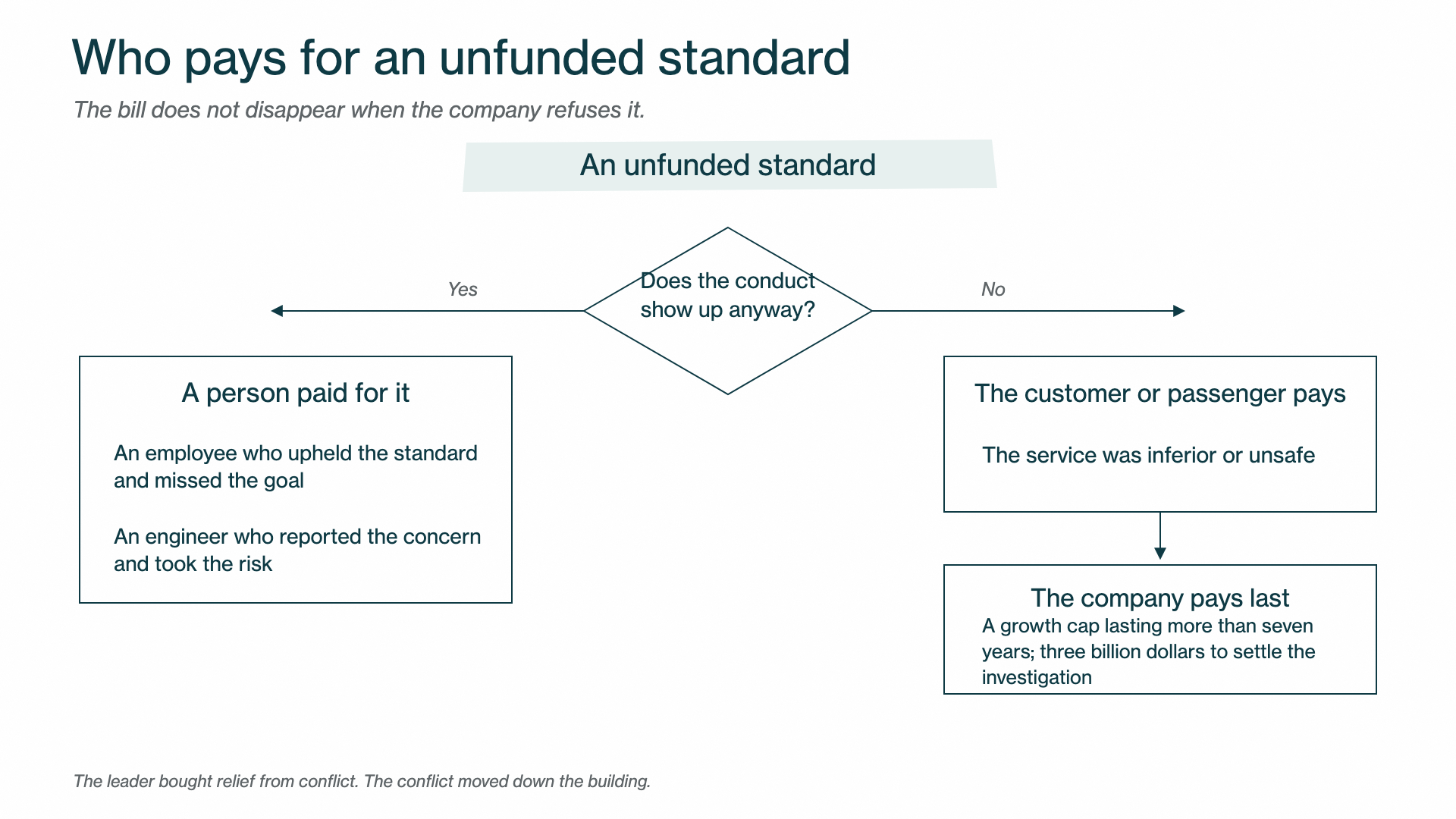
Consider the teller who refuses an unsuitable account and misses her goal, or the engineer who reports a concern despite the risk of retaliation. When employees uphold a standard against the pressures of the job, the company benefits from convictions it did not create and sacrifices it did not make.
The page takes the credit and they take the cost.
When the conduct does not appear, the cost can reach the customer or the passenger. The company may pay later. Wells Fargo faced a Federal Reserve growth cap imposed in 2018 that lasted more than seven years.[11] It also agreed to pay three billion dollars in 2020 to settle government investigations into its sales practices.[12]
The leader wanted relief from conflict. The conflict did not disappear. It moved down the building, to people with less power to resolve it and more to lose by trying.
An unfunded standard has another use. A standard that no conduct would clearly break is a standard that any conduct can be said to break. A vague requirement can be enforced selectively against someone the company wants to remove. “Not a fit with our values” turns a dismissal into a verdict on character. Without a clear account of the conduct required, unfair use is harder to challenge.
Others watch who receives an exception and who receives a penalty. The lesson is not integrity or customer focus. It is to stay in favor.
An unevenly enforced standard is not half funded. It is funded in reverse. It teaches a rule the company would never put on the page.
That is the further problem with treating culture as an internal supervisor. It allows a company to demand personal commitment while leaving contradictory instructions intact. The employee must reconcile them, absorb the cost, and still be judged against the announcement.
Paying Without A Supervisor At Every Desk
The repair does not require funding every aspiration. It requires the company to stop advertising what it will not support.
For each line on the page, ask four questions. What conduct would break the standard? Who can notice and report it safely? What happened after the last breach, including to the person who reported it? Who was promoted, and for doing what?
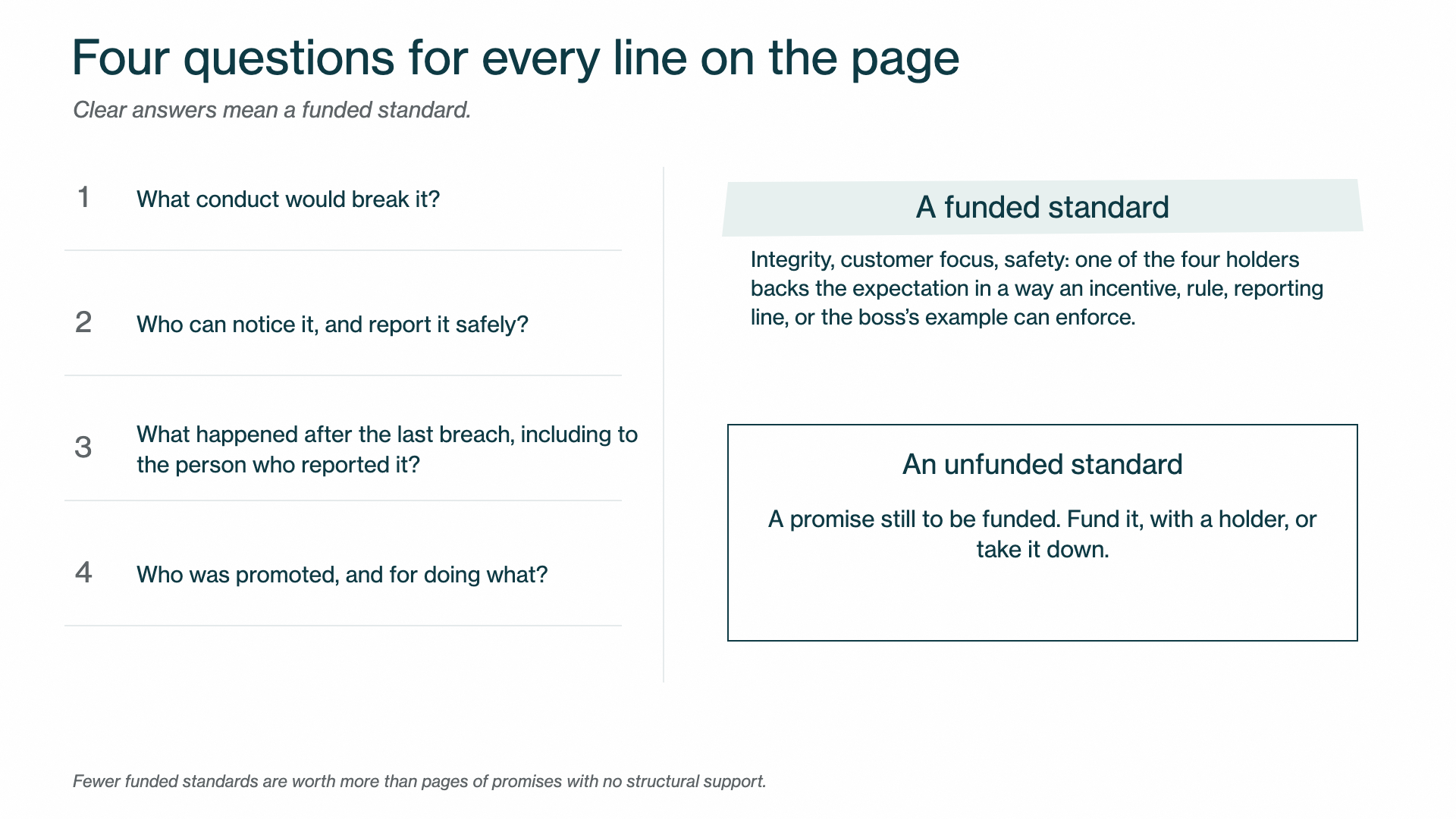
These questions test the company’s commitment, not employees’ ability to repeat its words. A standard with clear answers has support that can be examined. One without them is a promise still to be funded.
The earlier essay identified four things that hold workplace habits in place: an incentive, a rule, a reporting line, or the boss’s example.[2] Funding means making those arrangements support the announced conduct. Fund the standard with one of them, or take it down.
That does not mean a supervisor at every desk. Incentives reward choices. Reporting lines establish responsibility. The boss’s example shows which promises survive inconvenience. These mechanisms can sustain conduct without anyone checking every action. The byculture is held by incentives and example far more than by rules.
This is the part of the company’s hope that was sound. It wanted dependable conduct without constant supervision. That is available. It is just not available by announcement.
Rules backed by penalties should be kept for the standards where a breach creates serious harm: safety, money, and the truth told to customers and regulators. Schein’s example concerned one behavior, not forty.
Every enforced rule costs attention, and each one added returns less conduct than the last, until the rules are competing with the work. A company that tries to watch everything risks crowding out the judgment and mutual correction it needs. The answer is not a larger rulebook. It is fewer promises with dependable support. Three funded standards are worth more than twelve that disappear at the first difficult case.
A company can buy advice, workshops, and posters. It cannot buy the continuing decision to uphold a standard when doing so threatens revenue, convenience, or a powerful person’s standing. That decision remains its own.
Companies do not need to acquire a culture to become better places to work. They need to understand the habits they have and accept responsibility for what sustains them. The change begins when leaders stop asking whether employees believe the announcement and start asking what it costs to act on it.
A company cannot buy a culture. It can pay for conduct. And when it will not, the question is who has been paying instead.